Winter Weather in the Borough: Emergency Contacts, Salt Routes, and Power Cut Tips
The first real cold snap rarely announces itself. A forecast mentions "wintry showers", the sky turns the colour of wet cardboard, and by Tuesday morning the side streets are glass and the 7.40 bus is nowhere in sight. Most of what turns an awkward week into a genuinely difficult one comes down to a few things decided in advance: who you ring, where the grit actually goes, and whether the person three doors down still has heat.
None of it takes long to sort out. Here is what is worth knowing before the temperature drops again.
Get the small things ready tonight
Most winter problems are boring ones — a frozen pipe, a flat torch, a phone at 8 per cent when the lights go out. A few minutes now saves an expensive afternoon later.
- Find your stopcock. If a pipe bursts, you need to turn the water off in seconds, not hunt for the valve in the dark.
- Leave the heating on low rather than switching it off entirely when you go out. A cold house is a house with frozen pipes.
- Keep a bag of rock salt by the door, along with a shovel you can actually lift.
- Charge a power bank and check the torches. Batteries are cheap; candles in a power cut are not worth the risk.
- Collect two or three days of any regular prescription before the forecast turns, so you are not relying on a delivery in ice.
- Stock food that needs no cooking — a power cut takes the microwave, the kettle and the hob with it.
Emergency numbers worth saving now
Save these while the signal is good and you are not standing in a cold hallway.
- 999 — someone injured, trapped, or in immediate danger.
- 101 — police matters that are not emergencies.
- 111 — NHS advice when you are unwell but it is not a 999 situation.
- 105 — the free national line for reporting a power cut and checking when supply should return.
- 0800 111 999 — if you smell gas or suspect a leak. Ring from outside if you can, and do not touch light switches.
- Your council's out-of-hours line — for gritting queries, fallen trees, blocked drains and flooded roads. The number sits on the council website; save it rather than searching for it in a hurry.
- Your water supplier — for a burst main in the street or a loss of supply.
A missed bin collection, a power cut or an ungritted side street is not a 999 call. If you are unsure whether something counts as an emergency, ring the council or 101 and let them decide.
How gritting works — and what it cannot do
Start with the honest part: no council can salt every street. Routes are ranked, and the ranking rarely changes.
What gets treated first
- Primary routes: main roads, bus routes, steep hills, and the approaches to hospitals, fire stations and town centres.
- Secondary routes: other busy roads and the link roads into housing estates.
- Residential streets: usually only during sustained severe weather, and sometimes not at all.
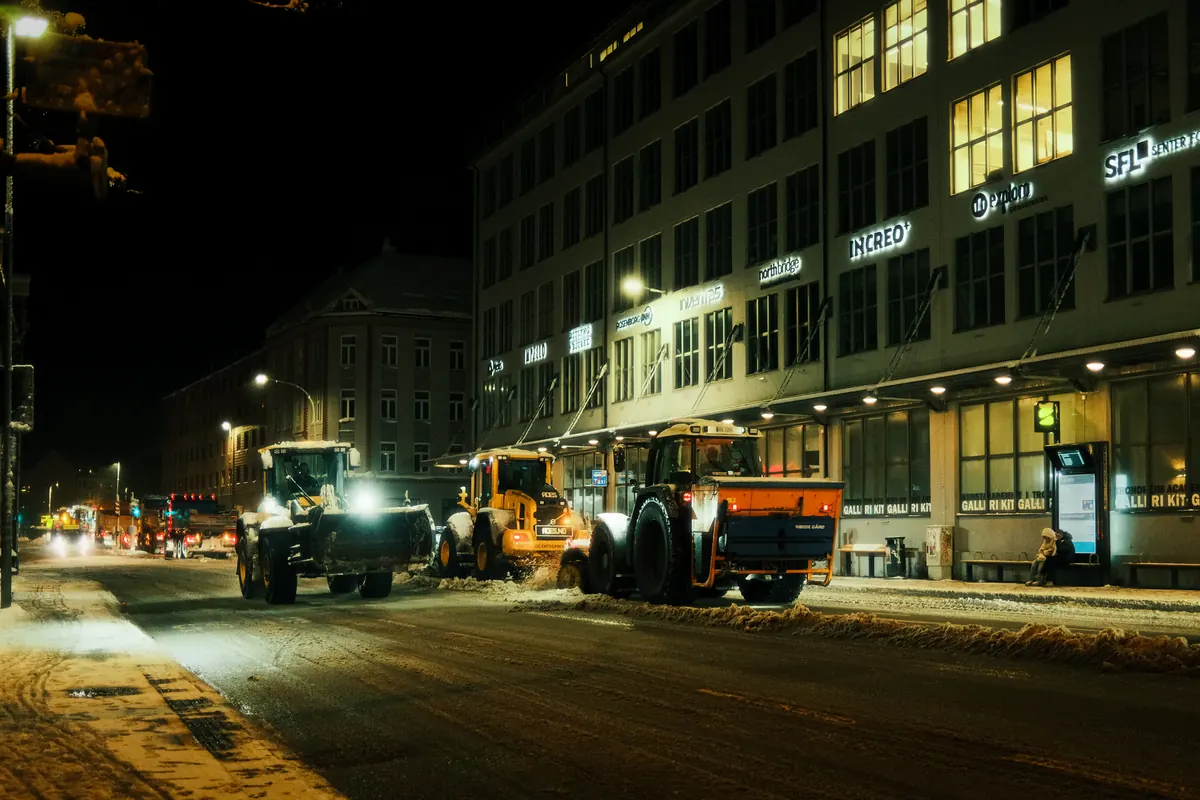
Grit is not a coating that makes ice vanish. Rock salt needs traffic to grind it into the surface and start the melting process, which is why a treated road can still be slippery — particularly on bridges and anywhere the gritter passed before the traffic did. Salt also loses much of its effect at very low temperatures, so councils may add other treatments when the thermometer drops further.
Gritters run overnight and in the early hours, before the morning rush. If your street was missed and the main road was done, that is the system working as designed rather than a driver skipping your road.
Pavements, paths and driveways
Clearing the pavement outside your home is not a legal duty in most cases, but it makes the street safer for everyone. If you are going out with a shovel:
- Clear early, before snow is compacted into ice by feet and tyres.
- Shovel snow to the side of the path — never onto the road, where it refreezes into a hazard.
- Salt after clearing, not instead of clearing.
- Skip the boiling water. It refreezes quickly and can crack paving and damage mortar.
Grit bins are for public pavements, not driveways. If a bin near you is empty, report it to the council rather than assuming someone else already has. And if you have cleared your own frontage, the few metres next to an older neighbour's gate is a small extra job that makes a real difference.
When the power goes out
First, check whether it is just you. Look at the street. If next door's lights are out too, it is a network fault rather than your fuse box.
The first hour
- Report it on 105, or to your supplier if you know the number from your bill.
- Unplug sensitive electronics, and leave a lamp switched on so you can see the moment power returns.
- Keep the fridge and freezer shut. A full freezer holds its temperature for a long time if you resist opening the door to check.
- Close the doors on rooms you are not using and layer up. Heating systems need power, so extra blankets matter more than fiddling with the thermostat.
- If you rely on powered medical equipment, a stairlift or a home dialysis machine, call your supplier and ask to be added to the Priority Services Register. It flags your address so you get extra help during an outage.
What not to do
Do not bring a camping stove or barbecue indoors, into a garage or into a shed. Carbon monoxide is odourless and kills people every winter. The same goes for petrol generators — they belong outdoors, well away from windows and vents. Never leave a candle burning unattended.
If you are worried about your health during a long outage, ring 111. For anything urgent, it is 999.
Knock on one door
The people who struggle most in cold weather are often the ones least likely to ask. Older residents, anyone living alone, people with mobility problems, new parents, and anyone whose car has not moved in three days are all worth a knock.
Ask a specific question rather than a general one. "Have you got heat and hot water?" gets a more useful answer than "Are you alright?" Offer something concrete — a pint of milk, a lift to the pharmacy, a phone charged for an hour. If someone does need medical help and the roads are bad, 111 can advise on the best route.
A five-minute job before you close the curtains
Save the numbers. Find the torch and put it where you can reach it in the dark. Check the salt bag. Then knock on one door.
Cold weather is rarely dramatic, but it is unforgiving of the things we meant to do last week. If the heating is on low, the stopcock is findable and one neighbour knows you are thinking of them, you have done the important part. If money is tight this winter, help with heating costs and insulation is worth asking the council about directly — and for anything involving your health, your benefits or your tenancy, a qualified adviser will give you better guidance than a neighbour's opinion.
Photo: Dua'a Al-Amad / Pexels